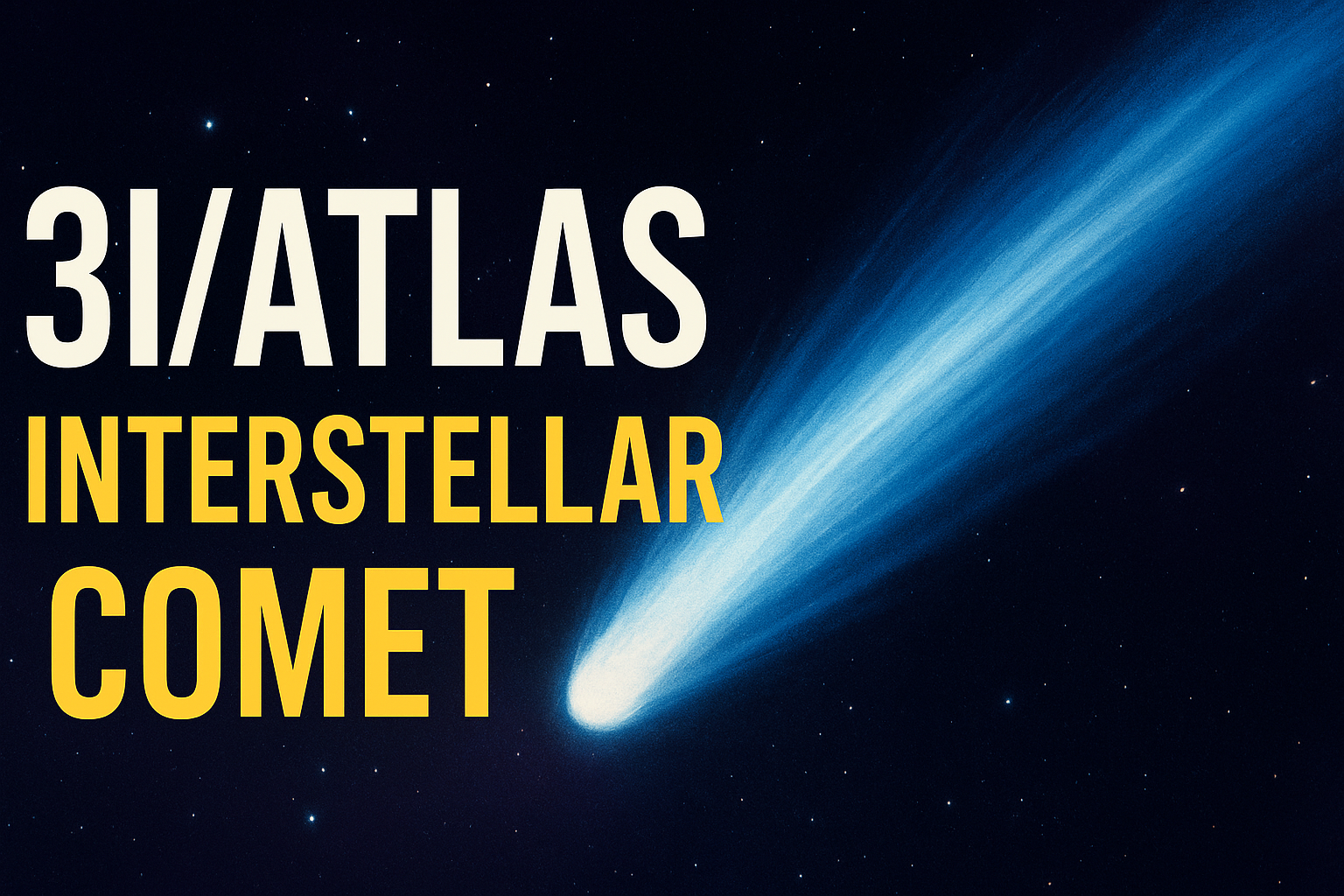
In mid-2025, astronomers spotted something extraordinary: a fast-moving celestial object on a path that couldn’t be explained by ordinary orbits in our solar system. It wasn’t a typical asteroid or comet—it was an interstellar comet, officially designated 3I/ATLAS. That “3I” tells us two important things:
- It’s the third confirmed object known to come from outside our solar system,
- and it was discovered by the ATLAS survey telescope in Chile. NASA Science+1
How Do We Know It’s Interstellar?
Most comets and asteroids orbit the Sun in elliptical paths that keep them bound to our solar system. 3I/ATLAS doesn’t. Its path is hyperbolic, meaning it’s not gravitationally bound to the Sun and will eventually leave our solar neighborhood forever. This high-speed trajectory, combined with its inbound direction and acceleration, tells astronomers unmistakably that it came from far beyond. NASA Science
Discovery and Naming
The object was first reported on July 1, 2025, after the NASA-funded ATLAS (Asteroid Terrestrial-impact Last Alert System) survey spotted it while scanning the skies for potentially hazardous objects. The name 3I/ATLAS breaks down like this:
- 3I → Third interstellar object ever confirmed,
- ATLAS → Named after the telescope system that discovered it. NASA Science
What Is It Like?
Astronomers have used powerful telescopes—like Hubble, James Webb Space Telescope (JWST), and ground-based facilities—to learn about 3I/ATLAS. Here’s what they’ve found so far:
✅ Cometary Behavior
Unlike the rocky interstellar visitor 1I/‘Oumuamua, 3I/ATLAS behaves like a comet. It has an icy nucleus surrounded by a coma of gas and dust that forms as sunlight warms the surface and causes volatile materials to sublimate. This is classic comet activity.
✅ Size
Estimating size for comets is tricky because the bright cloud around them can hide their solid core. Based on Hubble observations, scientists think the nucleus of 3I/ATLAS is somewhere between about 0.4 and 5.6 kilometers across.
✅ Speed
At discovery, the comet was whizzing through space at about 137,000 miles per hour (221,000 km/h). As it neared the Sun’s gravity well, it picked up speed—typical comet physics—but it’s still on a one-time visit. NASA Science
Chemical Clues from Deep Space
One of the most exciting developments in 2025 has been the chemical analysis of the comet’s coma:
- Scientists have detected methanol, hydrogen cyanide, and other organic compounds—important molecules in prebiotic chemistry. These are the kinds of chemicals that, under the right conditions, contribute to forming complex molecules related to life. The Times of India
- Observations with space telescopes (including JWST) suggest that carbon dioxide may be unusually abundant in the comet’s outgassing, possibly more so than water, which differs from typical solar system comets. This kind of composition hints at the environment in which the comet formed in its home star system. arXiv
Why This Matters
Interstellar visitors like 3I/ATLAS act as tiny messengers from other star systems. They give us a direct sample—albeit remotely observed—of the materials that exist elsewhere in the galaxy. By studying these rare objects, scientists can compare their composition and behavior to comets formed around our own Sun, offering clues about how planetary systems form and evolve across the Milky Way.
And because there are only two confirmed interstellar interlopers before this one (ʻOumuamua in 2017 and Borisov in 2019), each new discovery adds a huge amount to our understanding of the cosmos. NASA Science
Looking Ahead
3I/ATLAS won’t stick around. It passed its closest point to the Sun in late October 2025 and will continue outward, never to return. But while it’s been in our neighborhood scientists have thrown a whole fleet of observatories at it—space telescopes, Mars orbiters, and Earth-based telescopes—gathering one of the richest datasets ever for an interstellar object. Each observation helps piece together a story billions of years in the making.
Final Thought
3I/ATLAS isn’t just a visitor—it’s an opportunity. By watching it, measuring it, and analyzing its makeup, we’re learning not just about this one comet, but about the diversity of worlds beyond our own solar system. In the grand story of astronomy, these rare interstellar wayfarers are precious chapters we only get to read a few times in a lifetime.